

Training Objectives for Lean Six Sigma Yellow Belt
Lean Six Sigma can be used by many companies who are looking for ways to optimise operational costs to stay competitive. It can be applied in any organisation whether in a manufacturing or service industry. It has been proven across a wide range of industries including government agencies, automotive, transportation, banking, defence, manufacturing, healthcare, logistics, education, telecommunications, and construction.
Lean Six Sigma can be considered both as a business strategy and a science that has the aim of reducing operational costs. It creates significant improvements in customer satisfaction and bottom-line savings by combining statistical and business process methodologies into an integrated model of process, product, and service improvement. The main benefit of implementing Six Sigma is in the reduction of variation and subjectivity in decision-making through the creation of a system where everyone collects and analyses data in a cohesive and systematic manner.
The fundamental concept of Lean Six Sigma is to improve processes whilst improving the quality of the process outputs. By deploying Lean Six Sigma, the improvements are defined by their impact on customer satisfaction and value. From an internal perspective, Lean Six Sigma provides a way of improving processes so that any organisation can efficiently and predictably produce world-class products and services. Lean Six Sigma places a clear focus on bottom-line impact in hard savings.
Lean Six Sigma has also been very successful in integrating human aspects (such as culture change and customer focus) with process aspects (such as process stability and variation reduction). Lean Six Sigma links the tools and techniques in a sequential manner and combines with the notion that Six Sigma creates a powerful infrastructure for training key personnel in an organisation starting from the top management.
You can take a Quiz to determine which Six Sigma course you are best suited for : Six Sigma Programme Eligibility Quiz
Who Should Attend
General Managers, Managers, Executives, Engineers, Foreman, Team Leaders, Supervisors, Line Leaders, Junior Executives, Operators and Continuous Improvement Specialists & Others.
Departments
Business Process Improvement, Change Management, Continuous Improvement, Project Management, Industrial Engineering, Production Management, Quality Management, Logistics, Contract Department, Innovation Department, Commercial Department, Business Development, Strategic Planning, Human Resource, Finance & Others.
LSS Extended Yellow Belt Programme Content:
Exercises and activities conducted during the training workshops will be aligned to required work related project outputs.
- The Yellow Belt participants will have more in-depth knowledge of Lean and Six Sigma, and each of the five phases that are to be applied in practical terms.
- This course is designed to provide a broad understanding of the Lean and Six Sigma improvement methodology, concepts, and language, along with a complete toolbox of basic process improvement methods.
- The Six Sigma Yellow Belt course is designed to enhance technical problem-solving skills. Instruction is application focused, therefore requiring all participants to successfully support existing or new Lean and Six Sigma projects.
- The Yellow Belt upon completion of this training will participate as a core team member or subject matter expert on a project or projects together with the supervisors/managers.
- The tools and deliverables of the Six Sigma Yellow Belt Program modules / topics are as below. The course curriculum and modular topics including workshops are a blend of Lean and Six Sigma as outlined below.
Availability / Schedule: any 3 mutually convenient consecutive dates (9am – 3pm) for online sessions. Training is conducted via Zoom.
Certification: will be based on full attendance to this training programme and passing the examination requirements (passing mark 70% and above).
A3 Report Completion During Lean Six Sigma Training
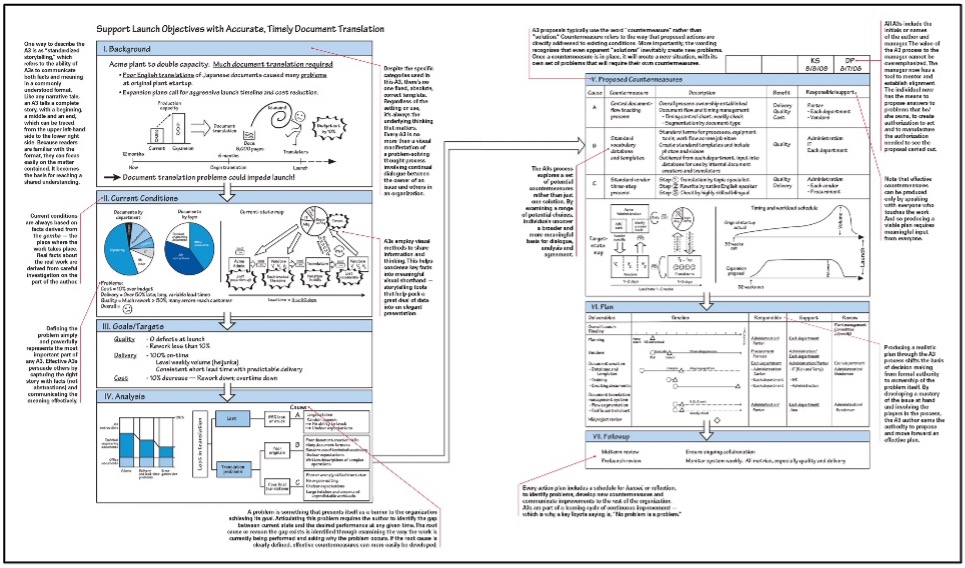
The Lean A3 report is a structured problem-solving and continuous improvement tool central to Lean thinking, particularly within the Lean System. Named after the A3-sized paper it’s traditionally printed on, it distils complex issues into a concise, visual one-page document. It guides users through a systematic process—defining the problem, analyzing root causes, setting goals, developing countermeasures, implementing solutions, and tracking follow-up actions.
Its strength lies in promoting clarity, alignment, and collaboration across teams by emphasizing both the logic and the story behind the issue. More than just a report, it fosters critical thinking, ownership, and dialogue, reinforcing Lean principles of respect for people and relentless pursuit of improvement.
Examination, Assignment and Certification
We will administer an examination for the participants upon completion of their training. The examination consists of the following (on last day of training):
LSS YELLOW Belt Level (Internal Exam)
Exam Type : Multiple Choice Questions
No. of Questions : 15 Questions
Examination : Open Book Examination
Passing Rate : 70% and above
Duration of Exam : 30 minutes
Location of Exam : Online
Training Content and Timing Plan
- Overview of Lean and Six Sigma – DMAIC & Lean PDCA
- 7 Wastes TIMWOOD
- Cost of Poor Quality (COPQ)
- Pareto Charting (Prioritisation Tools, using Excel)
- Understanding Project Charters
- Root Cause Analysis (RCA) Tools
- Creating Fishbone Diagrams
- Fishbone Diagram with 5- Whys
- Data Collection Techniques
- Basic Lean Enterprise, Lean Ways of Working
- Workshop Sessions & Lean Video Analysis
- Basic Statistics and Graphical Analysis using Excel
- Process Flow Charts / SwimLane Diagrams (incl. SIPOC)
- Understanding Value Added (VA) and Non-Value-Added Activities (NVA)
- Types of Statistical Analysis (Quantitative & Qualitative)
- Workshop Sessions – 7QC Tools, RCA Tools, A3 Reports
- Generating Lean Improvement Ideas
- Poke – Yoke (Mistake Proofing)
- Identifying Solutions – Best Practices, Benchmarking, Brainstorming
- SOP & Documentation
- Workshops & Examination Sessions (Lean A3 Report Completion)